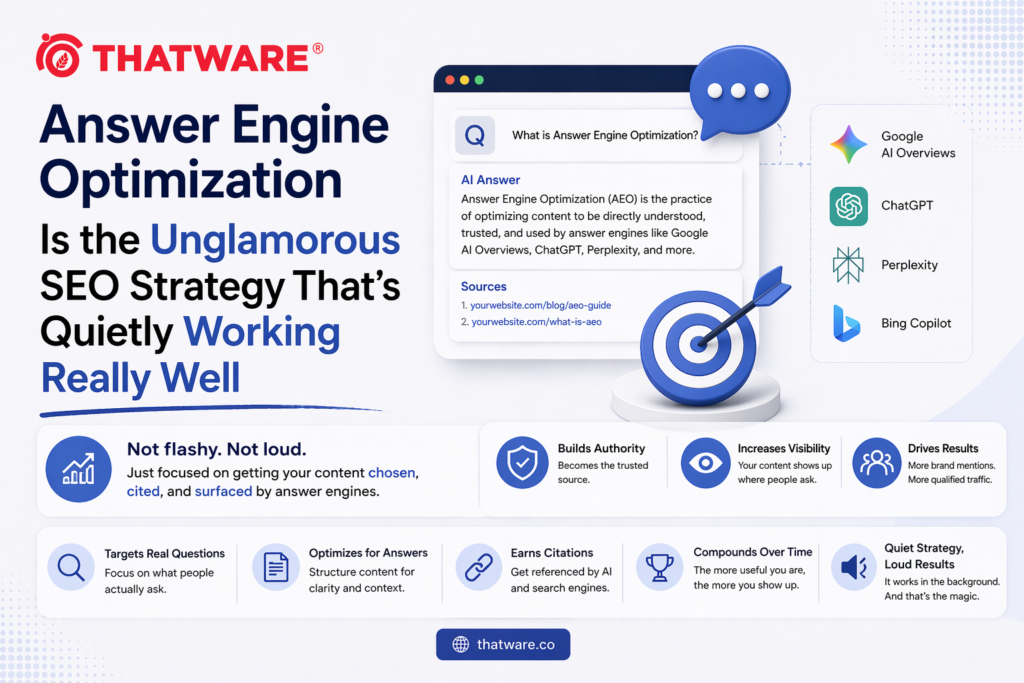
Nobody puts “answer engine optimization” on a conference keynote slide. There are no viral Twitter threads about it. It doesn’t have the cachet of AI-powered content tools or the excitement of quantum computing applied to search. It’s just… a really effective approach to SEO that a relatively small number of practitioners are doing really well while everyone else chases shinier things.
Which is exactly why it’s worth talking about.
What Answer Engine Optimization Is
Answer Engine Optimization — AEO — is the practice of structuring content to directly answer the specific questions that users are searching for. Not just covering topics broadly, but formatting and writing content in a way that search engines can easily extract as a direct answer to a query.
Featured snippets, People Also Ask boxes, voice search results, AI Overviews, knowledge panels — all of these are “answer engine” surfaces. They’re places where search engines go from surfacing pages to surfacing answers. AEO is about getting your content into those surfaces.
The approach is less about ranking for a keyword and more about being the clearest, most extractable answer to a specific question. Those are subtly different optimization targets.
Why It Works
Search engine behavior has been shifting toward answer delivery for years. Google’s explicit goal — stated multiple times in various forms — is to answer the user’s question, not just point them toward a page that might contain the answer. AI Overviews are an acceleration of that tendency, not a new direction.
What this means is that the search engine is increasingly acting as an answer engine itself. It’s reading your content, understanding it, and deciding whether it’s a good answer to a given question. If it is, it surfaces the answer. If it’s not clearly structured as an answer, it passes.
aeo services are specifically designed around this mechanism. They audit existing content for answerability, restructure it to be more extractable, identify question-format queries that don’t currently have a clear answer in the client’s content, and build new content explicitly designed to fill those gaps.
The Formats That Actually Get Featured
Not all content formats perform equally in answer engine surfaces. Some patterns reliably get extracted; others almost never do.
Definitions work well. If you’re trying to rank in the featured snippet for a “what is X” query, the content that gets pulled is almost always a clear, 40-80 word definition paragraph that starts by directly answering the question.
Step-by-step processes work well. Numbered lists that walk through a process clearly get pulled into featured snippets and AI summaries consistently.
Comparison tables work well. Side-by-side comparisons of options, clearly labeled, get extracted into structured answer formats.
FAQs work extremely well. The People Also Ask feature and AI Overview sections are built almost entirely on FAQ-style content. If you’re not writing explicit Q&A content on your pages, you’re leaving a significant optimization surface unused.
The Unglamorous Part
Here’s why AEO doesn’t get talked about as much as it should: it’s not particularly exciting work. Writing tight, clear, extractable definitions and structured FAQs is methodical and unglamorous. There’s no AI magic involved. It’s basically disciplined writing with a clear structural framework.
But methodical, unglamorous work that actually produces results is valuable. And the results from well-executed answer engine optimization services — in terms of featured snippet captures, increased visibility in AI-generated responses, and share of voice in zero-click search results — are substantial.
The click-through implications are complicated. Featured snippets sometimes reduce clicks because users get the answer without visiting. But they increase brand visibility, establish authority, and matter enormously in voice search contexts where there’s only one result. The net value calculation depends on your business model, but for most brands, the visibility and authority gains outweigh the click-through considerations.
Who Should Be Prioritizing This
Honestly? Almost everyone. But particularly: businesses where trust and authority matter, because answer engine visibility signals expertise. Local businesses, because voice search AEO translates directly into local discovery. E-commerce businesses with product category pages that could answer buying-guide questions. B2B companies whose prospects are researching solutions and trust the brand that answers their questions clearly.
The question isn’t whether AEO matters for your business. It almost certainly does. The question is whether you’re doing it deliberately or leaving it to chance.
Starting Points
If you want to start moving in this direction without overhauling your content strategy entirely, a few practical entry points: add explicit FAQ sections to your most important pages. Rewrite your key “what is X” content to lead with a crisp, clear definition paragraph. Identify the top questions your audience asks about your product or service category and create content that answers each one directly and completely.
None of that is technically complicated. All of it is consistently underdone. That gap between “not technically complicated” and “consistently underdone” is where a lot of easy SEO value lives.