

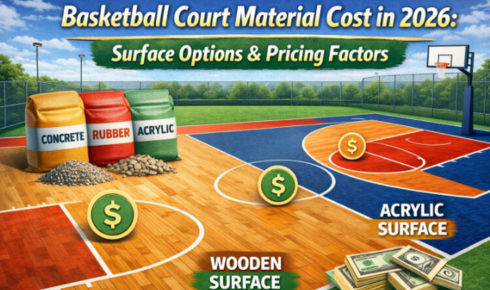
Understanding basketball court material cost is a crucial step before planning any new basketball court or upgrading an existing one. Whether the project is for a school, residential society, sports academy, or public facility, material selection and court size together determine the total investment and long-term value. In 2026, advancements in sports flooring have made basketball courts more durable and performance-oriented, but costs still vary based on several technical factors.
Why Basketball Court Material Cost Matters
Basketball is a high-impact sport that demands a surface capable of handling constant running, jumping, and quick directional changes. The material used for the court directly affects player safety, ball response, maintenance frequency, and durability.
Choosing the wrong surface may reduce initial cost but often increases long-term expenses due to repairs and resurfacing. Understanding basketball court material cost from a life cycle perspective helps decision-makers choose solutions that balance performance and budget.
Standard Basketball Court Size and Its Cost Impact
Before discussing materials, it is important to understand basketball court size. A full-size basketball court typically measures 94 feet long and 50 feet wide. This standard size is commonly used for professional and competitive play.
Half courts and practice courts are also popular, especially in schools and residential projects. Smaller court sizes naturally reduce material consumption and installation cost. However, regardless of size, surface quality must remain consistent across the entire playing area.
Basketball court size directly influences material cost because flooring systems are priced per square foot. Larger courts require more base preparation, coating layers, and labor, increasing the overall project cost.
Common Basketball Court Flooring Materials Used in 2026
Modern basketball courts rely on engineered sports flooring rather than plain concrete. Each material option has a different cost structure and performance profile.
Synthetic Acrylic Basketball Court Flooring
Synthetic acrylic is one of the most widely used materials for outdoor basketball courts. It consists of multiple acrylic coating layers applied over a concrete or asphalt base. This surface offers good traction, consistent ball bounce, and weather resistance.
Acrylic basketball court material cost is considered moderate, making it a popular choice for schools, parks, and residential communities. Its low maintenance requirements help control long-term expenses.
Cushioned Basketball Court Flooring Systems
Cushioned systems include elastic layers beneath the top surface to absorb impact. These systems are commonly used in academies and indoor facilities where player comfort is a priority.
Cushioned basketball court material cost is higher than standard acrylic flooring due to additional layers and specialized materials. However, the improved shock absorption can reduce injury risk and extend the court’s usable life.
Modular Sports Flooring
Modular tiles are often used for indoor basketball courts or multi-purpose halls. They are easy to install and replace but may not offer the same seamless ball response as continuous surfaces.
While modular flooring can lower initial installation time, long-term performance and ball consistency may vary depending on tile quality.
How Base Construction Affects Basketball Court Material Cost
Basketball court material cost is not limited to the surface coating alone. Base construction plays a major role in determining total project expense.
A well-prepared concrete base is essential for any basketball court. Poor base quality can lead to surface cracks, water accumulation, and uneven play. Repairing these issues later significantly increases overall cost.
Investing in proper base preparation at the start helps protect the surface material and reduces future maintenance expenses.
Outdoor vs Indoor Basketball Court Cost Differences
Outdoor basketball courts require materials that can withstand sunlight, rain, and temperature changes. Synthetic acrylic flooring is commonly used outdoors because it is UV-resistant and water-tolerant.
Indoor basketball courts focus more on cushioning, grip consistency, and visual clarity. Indoor flooring systems may cost more initially due to specialized materials but benefit from reduced weather-related wear.
The choice between indoor and outdoor courts directly impacts basketball court material cost and maintenance planning.
Role of Basketball Court Size in Budget Planning
Basketball court size affects more than just material quantity. Larger courts require more labor hours, longer curing times, and more detailed line marking.
Even for smaller courts, surface quality must meet performance standards. Reducing size should not mean compromising on material quality. A smaller court with high-quality flooring often delivers better long-term value than a larger court with inferior materials.
Understanding the relationship between basketball court size and material cost helps planners optimize budgets without sacrificing playability.
Maintenance Costs and Long-Term Value
Maintenance is a critical but often overlooked component of basketball court material cost. High-quality synthetic flooring systems require minimal routine maintenance, such as cleaning and periodic inspection.
Over time, surfaces may need recoating to restore texture and appearance. Compared to rebuilding a court, resurfacing is far more cost-effective. Courts built with quality materials typically have longer resurfacing intervals, lowering lifetime costs.
Evaluating material cost alongside maintenance needs provides a more accurate picture of total ownership cost.
Common Cost Mistakes to Avoid
Many projects focus solely on initial basketball court material cost, ignoring performance and durability. Choosing low-grade materials often leads to frequent repairs and early resurfacing.
Another common mistake is ignoring basketball court size during planning. Inaccurate measurements can result in material shortages or rework, increasing costs unexpectedly.
Working with experienced professionals and following standard specifications helps avoid these issues.
Trends in Basketball Court Materials for 2026
In 2026, basketball court materials are increasingly focused on player safety, sustainability, and durability. Manufacturers are developing surfaces with improved shock absorption and eco-friendly components.
These advancements may slightly increase initial material cost but offer better long-term performance and reduced maintenance, making them cost-effective over time.
Final Thoughts
Understanding basketball court material cost requires looking beyond surface prices alone. Material type, base preparation, indoor or outdoor use, and basketball court size all influence the final budget.
Modern synthetic flooring systems provide consistent play, improved safety, and long-term durability, making them the preferred choice for most basketball courts in 2026. By selecting the right materials and planning court size carefully, facility owners can achieve a balance between cost efficiency and performance.
A well-planned basketball court is not just an expense but a long-term investment in quality play and user satisfaction.
Title: Basketball Court Material Cost in 2026: Surface Options & Pricing Factors
Description: Learn about basketball court material cost in 2026, surface options, pricing factors, and how basketball court size impacts total project budget.


